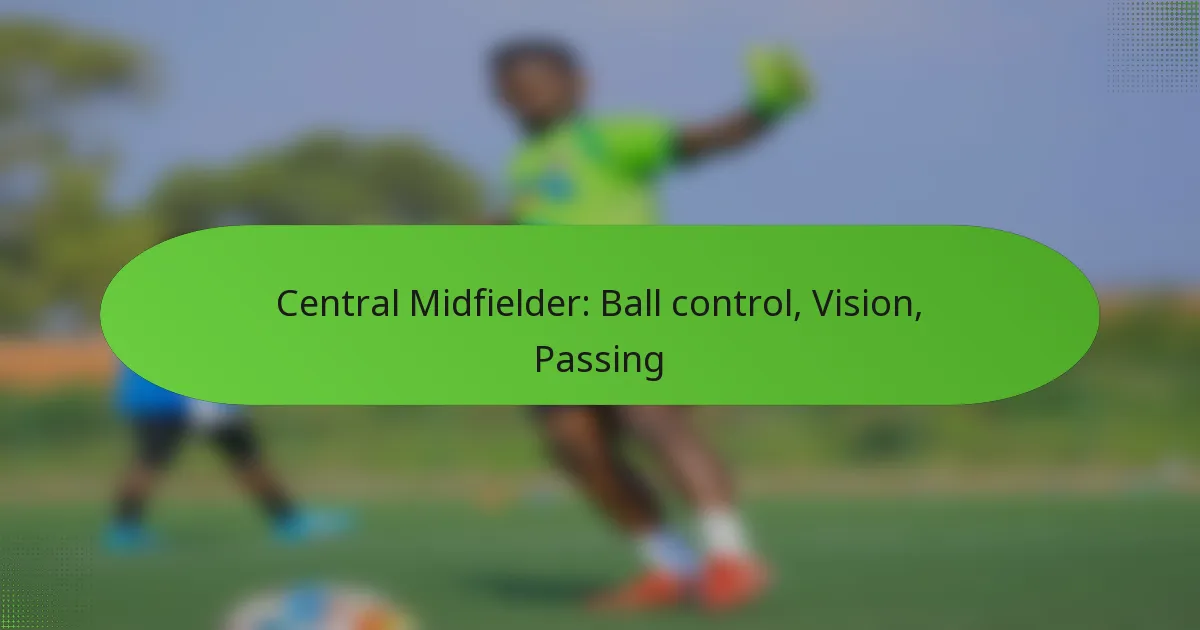
A central midfielder plays a pivotal role in a soccer team, requiring exceptional ball control, vision, and passing skills. Mastery of these abilities allows them to maintain possession, create scoring opportunities, and orchestrate the flow of the game. By honing their ball control and developing keen field awareness, central midfielders can significantly influence their team’s performance and strategy.
What are the key skills of a central midfielder?
A central midfielder must excel in ball control, vision, and passing to effectively manage the game and support their team. These skills are crucial for maintaining possession, creating opportunities, and facilitating team dynamics on the field.
Definition of ball control in soccer
Ball control refers to a player’s ability to receive, manipulate, and maintain possession of the ball under various conditions. This skill is essential for a central midfielder, as it allows them to execute plays and evade opponents effectively.
Good ball control involves techniques such as dribbling, trapping, and shielding the ball. A midfielder with strong control can quickly adjust their position and make decisions, which is vital in fast-paced game situations.
Practicing ball control can include drills that focus on touch, balance, and coordination. Players should aim to improve their first touch and ability to keep the ball close, especially under pressure.
Importance of vision for a central midfielder
Vision is the ability to see and understand the game as it unfolds, allowing a midfielder to anticipate plays and make strategic decisions. A midfielder with excellent vision can identify passing lanes and opportunities for teammates, enhancing overall team performance.
Having good vision involves not only observing the immediate surroundings but also predicting the movements of teammates and opponents. This foresight enables a midfielder to make quick, effective decisions that can change the course of a match.
To develop vision, players can engage in exercises that enhance awareness, such as playing small-sided games or watching professional matches to analyse decision-making processes. Understanding spatial relationships on the field is key to improving this skill.
Role of passing in midfield play
Passing is a fundamental skill for central midfielders, as it facilitates ball movement and helps maintain possession. Effective passing can break defensive lines and create scoring opportunities for the team.
There are various types of passes, including short, long, and through balls, each serving a different tactical purpose. A successful midfielder must be adept at choosing the right type of pass based on the game situation and the positioning of teammates.
Practicing passing accuracy and timing is crucial. Players should focus on drills that simulate match conditions, allowing them to improve their ability to deliver precise passes under pressure.
How these skills contribute to team dynamics
The combination of ball control, vision, and passing significantly impacts team dynamics. A central midfielder acts as a link between defence and attack, orchestrating play and ensuring smooth transitions.
When a midfielder possesses strong skills in these areas, it fosters confidence among teammates, encouraging them to make runs and create space. This synergy is essential for effective teamwork and can lead to more scoring opportunities.
Moreover, a midfielder’s ability to control the game tempo through these skills can dictate the pace of play, allowing the team to maintain composure or apply pressure as needed.
Examples of successful central midfielders
Notable central midfielders like Xavi Hernandez, Andrea Pirlo, and Luka Modric exemplify the key skills of ball control, vision, and passing. Their ability to read the game and execute precise passes has made them invaluable to their teams.
These players have demonstrated that mastering these skills can lead to both individual accolades and team success, showcasing the importance of a central midfielder in soccer.
Emerging talents such as Jude Bellingham and Pedri are also making their mark, indicating that the next generation of midfielders continues to prioritise these essential skills.

How can a central midfielder improve ball control?
Central midfielders can enhance their ball control through consistent practice and focused drills. Mastering ball control allows players to maintain possession, create opportunities, and dictate the pace of the game.
Drills for enhancing ball control
- Juggling: Start by juggling the ball with your feet, thighs, and head to develop touch and coordination.
- Wall Passes: Pass the ball against a wall and control it upon return, focusing on using different parts of your foot.
- Dribbling Cones: Set up cones and practice dribbling through them to improve agility and close control.
- 1v1 Situations: Engage in one-on-one drills to practice maintaining possession under pressure.
Techniques for maintaining possession
To maintain possession, a midfielder should use a soft touch when receiving the ball, allowing for better control. Positioning your body to face the direction of play is crucial, as it prepares you to make quick decisions.
Utilising both feet effectively can enhance your ability to manoeuvre around defenders. Practice using your weaker foot to receive and pass the ball, which will make you a more versatile player.
Keeping your head up while dribbling is essential for scanning the field and identifying passing options. This awareness allows for quicker decision-making and helps avoid unnecessary turnovers.
Common mistakes in ball control
A frequent mistake is relying too heavily on one foot, which limits options and makes it easier for opponents to predict movements. Ensure you practice with both feet to avoid this pitfall.
Another common error is failing to cushion the ball upon receiving it. Players often let the ball bounce away, leading to loss of possession. Focus on absorbing the ball’s momentum with a gentle touch.
Lastly, many midfielders neglect to keep their body balanced while controlling the ball. Poor balance can result in miscontrol and turnovers. Work on your core strength and foot positioning to maintain stability during play.

What is the significance of vision for a central midfielder?
Vision is crucial for a central midfielder as it enables them to assess the field, anticipate plays, and make informed decisions that influence the game’s outcome. A midfielder with strong vision can effectively connect with teammates and exploit defensive weaknesses, enhancing overall team performance.
Understanding spatial awareness
Spatial awareness refers to a player’s ability to perceive their surroundings and understand the positioning of teammates and opponents. This skill allows midfielders to identify open spaces and make strategic movements to receive or distribute the ball effectively.
Key attributes of spatial awareness include the ability to scan the field frequently and maintain a mental map of player positions. Midfielders with high spatial awareness can quickly adjust their positioning to create passing lanes or support defensive efforts.
Examples of spatial awareness in action include a midfielder making a run into space to receive a pass or repositioning to block an opponent’s movement. This awareness not only aids in ball control but also enhances overall team dynamics.
Reading the game: anticipatory skills
Anticipatory skills enable midfielders to predict the flow of the game and react proactively. By reading the game effectively, a midfielder can position themselves advantageously, intercept passes, or initiate counter-attacks before the play unfolds.
Effective anticipatory skills involve understanding opponents’ tendencies and recognising patterns in their play. For instance, a midfielder might notice that an opposing player frequently passes to a specific teammate and position themselves accordingly to intercept that pass.
Enhancing anticipatory skills can significantly impact gameplay. Midfielders who excel in this area often make quicker decisions, leading to more successful plays and reduced turnovers.
Vision drills for midfielders
Vision drills are essential for developing a midfielder’s ability to see the game clearly and make quick decisions. These drills often focus on improving spatial awareness, decision-making, and reaction times.
- Small-sided games: Playing in smaller teams encourages quick thinking and enhances vision as players must constantly assess their surroundings.
- Passing drills with movement: Incorporating movement into passing drills helps midfielders practice receiving and distributing the ball while maintaining awareness of other players.
- Vision training exercises: Activities that require players to identify targets or make decisions under pressure can sharpen their visual acuity and decision-making skills.
Regularly incorporating these vision drills into training can lead to significant improvements in a midfielder’s overall performance, allowing them to make better decisions and contribute more effectively to their team.

How does passing impact a central midfielder’s effectiveness?
Passing is crucial for a central midfielder’s effectiveness as it facilitates ball movement and creates scoring opportunities. A midfielder’s ability to pass accurately and strategically can significantly influence the flow of the game and the team’s overall performance.
Types of passes and their uses
Central midfielders utilise various types of passes to navigate the game effectively. Each pass type serves a unique purpose and can be employed based on the situation on the field.
- Short Pass: Used for quick, precise exchanges, often to maintain possession or set up a play.
- Long Pass: Effective for switching play or finding a teammate in a more advanced position, typically over greater distances.
- Through Ball: Aimed at penetrating defences by delivering the ball into space for a forward to run onto.
- Cross: Delivered from wide areas into the penalty box, often targeting strikers or attacking midfielders.
Understanding when to use each type of pass is essential for a central midfielder to maximise their impact on the game. The choice of pass can dictate the tempo and direction of play, making it vital to assess the situation quickly.
Passing accuracy and its importance
Passing accuracy is fundamental for a central midfielder, as it directly affects the team’s ability to maintain possession and create scoring chances. High accuracy ensures that teammates receive the ball in advantageous positions, allowing for fluid transitions and effective attacks.
To enhance passing accuracy, midfielders should focus on their technique, including body positioning, foot placement, and follow-through. Regular practice can lead to improved consistency, which is crucial during high-pressure situations in a match.
Common pitfalls include rushing passes or failing to assess the field before delivering the ball. Midfielders should develop the habit of scanning the field to identify options and make informed decisions, thus increasing their effectiveness.
Situational passing drills
Practicing situational passing drills can significantly improve a central midfielder’s passing skills and decision-making abilities. These drills simulate real-game scenarios, allowing players to refine their techniques under pressure.
- Small-Sided Games: Playing in reduced spaces encourages quick thinking and precise passing.
- Target Passing: Setting up targets at various distances helps improve accuracy and distance control.
- Passing Under Pressure: Drills that involve defenders applying pressure teach players to make quick, effective decisions.
- Combination Play: Practicing one-twos and overlapping runs enhances teamwork and fluidity in passing.
Incorporating these drills into regular training can lead to noticeable improvements in a midfielder’s passing capabilities. Consistent practice not only builds skill but also boosts confidence in real match situations.

Which styles of play benefit from strong central midfield skills?
Strong central midfield skills are essential for styles of play that prioritise ball control, vision, and passing accuracy. Teams that focus on possession-based strategies particularly benefit from these skills, as they enhance tactical flexibility and decision-making on the field.
Possession-based play and its requirements
Possession-based play emphasises maintaining control of the ball to create scoring opportunities. This style requires players to have excellent ball control, allowing them to navigate tight spaces and evade defenders. Central midfielders play a crucial role in this system, as they are often the link between defence and attack.
Key requirements for effective possession-based play include high passing accuracy and the ability to read the game. Central midfielders must be able to deliver precise passes to teammates while also anticipating the movements of opponents. This vision allows them to make quick decisions that can shift the momentum of the game.
- Ball Control: Essential for maintaining possession and executing plays under pressure.
- Vision: Enables midfielders to see passing lanes and make strategic decisions.
- Passing Accuracy: Critical for ensuring successful ball distribution and maintaining possession.
In possession-based systems, tactical flexibility is vital. Central midfielders must adapt their positioning based on the flow of the game, often transitioning between defensive and offensive roles. Effective decision-making in these situations can significantly influence the outcome of matches.
About the Author